Rules & Regulations
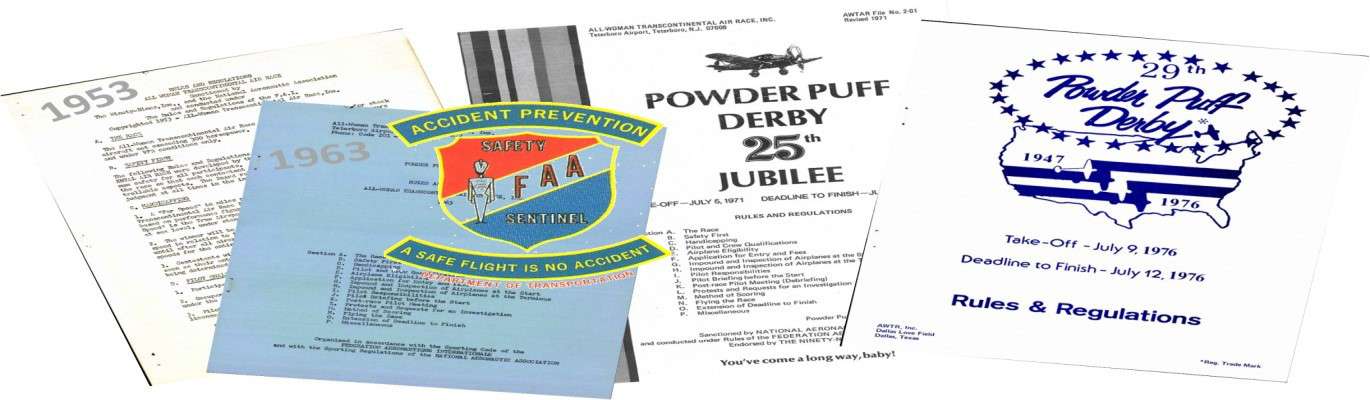
Each year the AWTAR/Powder Puff Derby Board of Directors revaluated and revised the rules that governed the race. Over the years rules and requirements were added to promote safety and to reflect advancements in aircraft design and manufacturing. While the earlier race rules were fairly simple ( see example 1950 race rules), the rules evolved to be quite comprehensive (see example 1976 race rules). Some of the rules created for the AWTAR were further adopted by the FAA and can be seen in FAA rules today:
- Two-way radio communication and standard procedures to call the tower.
- Pilot requirement of a minimum of 100 hours solo including 25 hours cross-country time.
- Start inspections with required AD (Airworthiness Directive) compliance for airplane safety. An FAA inspection within 100 hours of operation and within three months of race start.
- Use of oxygen for flights above 10,000 feet.
In 1962, to reduce the number of entries, pilot requirements were upgraded to a commercial certificate, or a private certificate with instrument rating. For a team of two, if the pilot had an instructor rating then the copilot could have a private certificate.
You are to be applauded for your careful management and sensible rules of your previous races, but your new rule this year … is a real safety advance. You are wise to let your beginner pilots serve as copilots and build time and experience. — Najeeb Halaby, then FAA Administrator
As airplanes, air traffic, and avionics became more complex, the three days prior to take-off at the start served as a platform for building pilot proficiency. Contestants received educational material, extensive briefings, and attended short seminars presented by experts.
The fairness of timing and handicaps was a primary concern for all racers and race officials. While timing for the first two years (1947 and 1948) was on the honor system, it was recognized that a more formal system was needed. Time clocks were set up at check-in airports. As an airplane taxied in and shut down, the pilot (or preferably, a speedy copilot) "sprinted" to the time clock to stamp the time on her time card. While the time clock was accurate to the minute, over the years timers on the ground were trained to write the seconds on the time card. In the 1960's the fly-by for timing was created, where timers on the ground clocked each airplane to the second as it flew by the timing line at the check-in airport. The fly-by technique made timing safer and fairer, as well as more accurate, and is still used in today's ARC as a backup timing technique.
Each airplane was assigned a handicap (or "par speed") based on the manufacturer's performance figures for that make and model (and sometimes year of manufacture). Scores were based on each team's times compared to the handicap speed. The early years (1949 – 1951) calculated a percentage of handicap, but subsequent years calculated ground speed over the length of the course compared to handicap (the method used by today's Air Race Classic). The team that exceeded their handicap by the most was the winner.
The stringent rules and infinite preparation by race officials and racers brought 30 years of Powder Puff Derbies to a conclusion without a fatality! It is self-evident that strict aircraft inspections, emphasis on upgrading pilot qualifications, and educational programs, including mandatory safety briefings, contributed to this record.
Project Sponsors